
9 Contractor Backed Bathroom Trends UK Homes Need for 2026
Read nine contractor backed UK bathroom trends for 2026, with practical advice on tile-drenching, ventilation, smart fixtures and realistic renovation costs.
9 Contractor Backed Bathroom Trends UK Homes Need for 2026
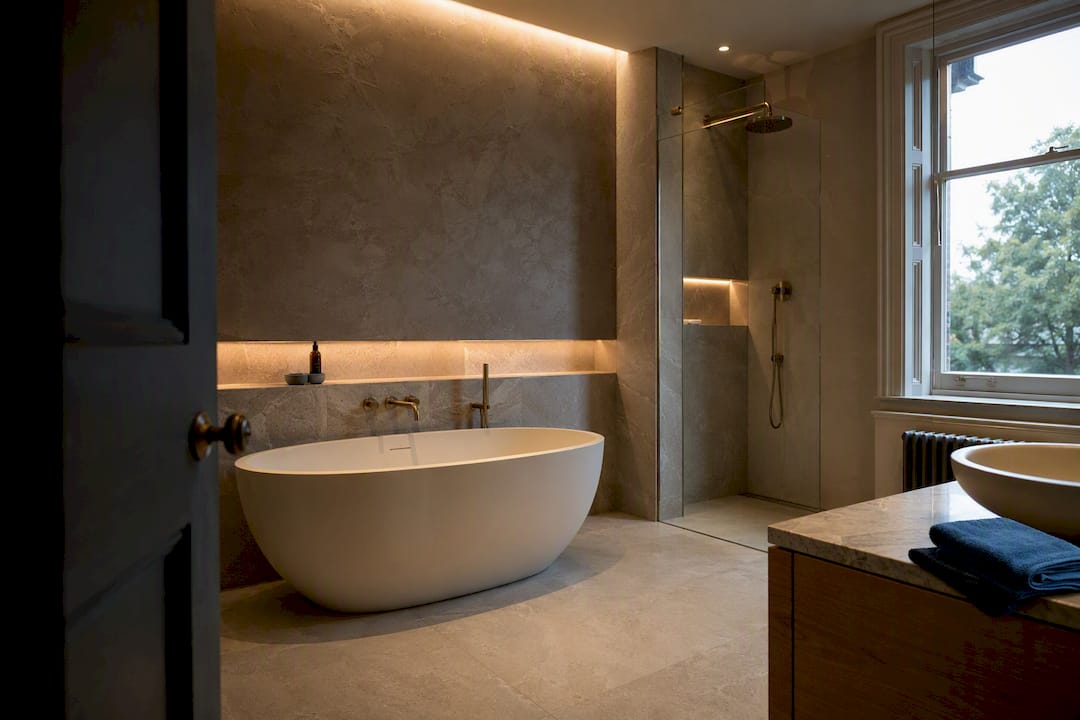
Warm minimalism has replaced the stark white bathroom as the defining look for 2026 in the UK. It is built around wellness-focused “spa” design. Earthy neutrals like greige and sage, textured large-format tiles, and layered warm lighting carry the trend into real renovations. For homeowners, that means rethinking paint, tile format, fixture finish, and ventilation together rather than picking each in isolation.
TL;DR:
- Warm neutrals like greige, taupe, and organic whites with accent colors such as sage and terracotta dominate the 2026 UK bathroom palette.
- Large-format tiles and textured finishes, including textured stone-look porcelain and relief patterns, are recommended for a seamless, tactile finish that makes small spaces feel larger.
- Smart fixtures like digital showers, LED mirrors, and humidity-sensing extractor fans are now standard, but zoning and safety regulations must be carefully followed.
- Renovations should prioritize wall-hung basins and toilets, recessing storage, and frameless glass screens to maximize space in small bathrooms.
- Natural materials like limewash and reclaimed brassware are trending for durability and sustainability, especially in period properties.
Table of Contents
- What Are the Bathroom Trends for 2026 in the UK?
- Choosing Warm Neutrals and Accents That Won’t Date
- Tile-Drenching, Large-Format Slabs, and Textured Finishes
- Lighting and Smart Fixtures That Make a Bathroom Feel Like a Spa
- Layout, Storage, and Small-Bathroom Fixes That Actually Work
- A Contractor’s View: Applying 2026 Trends on a Real Cardiff Job
- Bathroom Tech Worth Considering This Year
- Ventilation and Humidity Control for UK Bathrooms
- UK Regional Color Preferences Behind the 2026 Palette
- Sustainable Materials Beyond the Taps and Showerheads
- Which Trends Are Worth Choosing for Lasting Style
- Ready to Bring 2026 Bathroom Trends Into Your Home?
- Sources
- FAQ
What Are the Bathroom Trends for 2026 in the UK?
If you’re gutting a bathroom this year, nine trends keep showing up across UK design reports, and most of them work together rather than competing.
1. Warm minimalism and soft luxury. Cool grey and stark white are giving way to beige, greige, stone and warm taupe, often lifted with sage, jade or terracotta accents. Porcelanosa’s 2026 trend research ties this directly to Pantone’s warmer color direction for the year. For a UK renovation, this usually means swapping a cool white tile for a warm off white porcelain and repainting woodwork in a soft taupe rather than brilliant white.
2. Spa-inspired wellness design. This isn’t about candles and a bath tray. It’s functional: ambient layered lighting, natural materials, and a deliberate “digital detox” feel that keeps screens and harsh task lighting out of the main bathing zone.
3. Textured and sculpted tiles. Zellige-style glazed tiles, relief patterns and stone-look porcelain are replacing flat gloss finishes almost everywhere.
4. Tile-drenching. Running the same tile across floor and walls, sometimes into a shower niche, removes visual breaks and makes small rooms feel larger. Porcelanosa’s trendbook flags large-format, low-joint surfaces as one of the year’s clearest directions.
5. Mixed metals with a finish hierarchy. Brushed brass taps with aged bronze door furniture works, but only when one metal clearly leads and the second plays a supporting role. Three competing finishes in one room reads as clutter, not curation.
6. Statement baths and “bathscaping.” A sculptural freestanding tub, styled with a small stool, a plant, and a single piece of art, is doing the job a whole feature wall used to do.
7. Biophilic and Japandi materials. Warm timber vanities, woven textures and stone basins are pulling Japandi influence into UK bathrooms, particularly in period properties where timber already sits naturally.
8. Smart and sustainable fixtures. Thermostatic digital showers, low-flow taps and LED mirrors with demist functions are moving from luxury add-on to standard spec on mid-range renovations.
9. Small-bathroom solutions. Wall-hung basins and toilets, plus large-format tiles that cut down grout lines, remain the most reliable way to make a boxroom bathroom feel bigger.
Pro Tip: Before committing to a full tile-drench, order a full-size sample tile and prop it in the actual bathroom for 48 hours. UK daylight through a north-facing window reads completely differently to the showroom lighting the tile was picked under.
Choosing Warm Neutrals and Accents That Won’t Date
The 2026 palette is built on warm neutrals, not a single trendy color. Greige, stone, warm taupe and organic off-whites form the base, with sage, jade, terracotta and the occasional deep navy used sparingly as accent tones, a shift Porcelanosa’s trendbook links to Pantone’s broader move toward warmth. Sage in particular has become the accent color designers reach for first, sitting comfortably between a neutral scheme and a fully biophilic one.
Material pairing matters as much as color choice:
- Warm oak or walnut vanities against stone-look porcelain floors
- Limewash or textured plaster on one feature wall, left unglazed for a matte finish
- Natural stone (marble, travertine) in low-splash zones only, with porcelain doing the heavy lifting in wet areas
- Brushed brass or aged bronze hardware to warm up a cooler tile base
Natural stone looks superb but needs sealing and is genuinely harder to maintain in a UK climate where bathrooms rarely get proper cross ventilation. Porcelain copies the look convincingly and costs less to keep looking good over ten years. Before you commit to a darker palette, check the room’s natural light. Design commentary this year has been consistent on one point: a windowless bathroom in navy or deep sage needs a genuinely well-planned lighting scheme, or it reads as gloomy rather than moody.
Tile-Drenching, Large-Format Slabs, and Textured Finishes
Tile-drenching means running one tile, one grout color, across floor and walls without a break at skirting height. It’s the single fastest way to make a small UK bathroom look considered rather than assembled from separate decisions. Large-format porcelain slabs, often 600mm by 1200mm or bigger, cut the number of grout lines dramatically, which matters both visually and for cleaning.
Textured options like zellige and stone-look porcelain add depth without needing pattern. A few practical points worth knowing before you tile:
- Large-format tiles need a genuinely flat substrate. Uneven walls that a smaller tile would hide will show through a big slab.
- Textured and handmade-style tiles vary slightly piece to piece, which is the point, but it also means ordering a little extra to allow for sorting.
- Wet-room waterproofing (tanking) has to go on before tiling, not after, and needs to be compatible with your chosen adhesive system.
- Natural stone needs sealing on installation and periodically after; porcelain doesn’t.
You don’t need to tile-drench the whole room to get the look. A feature wall behind the bath or a fully clad shower niche in a textured stone-look tile gives you the tactile 2026 finish at a fraction of the material cost. Full guidance on pattern choice sits in our bathroom tile patterns guide.
Pro Tip: Ask your tiler to dry-lay a full pack before fixing anything. Textured tiles with natural variation can cluster oddly if laid straight from the box in sequence.
Lighting and Smart Fixtures That Make a Bathroom Feel Like a Spa
Lighting temperature does more work than most renovators expect. Porcelanosa’s trend research recommends warm white in the 2700K to 3000K range for a relaxing feel, layered so grooming tasks still get proper light where you need it.
A workable three-layer scheme looks like this:
- Ambient: a central warm-white fitting or cove lighting, 2700K to 3000K
- Task: LED mirror lighting around the vanity for shaving and skincare, same warm range
- Accent: a low-level strip along a niche or freestanding bath to add depth after dark
On the fixture side, thermostatic digital showers, low-flow taps, and demist LED mirrors are now standard asks on most jobs. Underfloor heating pairs well with large-format porcelain and cuts the need for a wall-mounted radiator, freeing up space in smaller rooms.
Any electrical work in a bathroom falls under zoned safety rules covering how close a fitting can sit to water and what IP rating it needs. Always get a qualified electrician or your contractor to confirm zoning before ordering fittings, not after.
Layout, Storage, and Small-Bathroom Fixes That Actually Work
Small UK bathrooms, the boxroom conversions and old-house en-suites, respond to a specific set of moves rather than clever paint tricks.
1. Go wall-hung. Wall-hung basins and toilets with concealed cisterns free up floor space and make cleaning easier, a tactic backed consistently by UK retail trend reporting from Bassetts.
2. Cut the grout lines. Large-format tiles reduce visual clutter on the floor, which reads as more space even when the square footage hasn’t changed.
3. Recess what you can. A niche cut into the shower wall beats a shelf that eats into showering room, and a recessed mirror cabinet does the same for the vanity wall.
4. Choose frameless glass. A frameless screen lets light travel through the whole room instead of stopping at a metal frame.
5. Know when a wet room makes sense. A full wet room only works with proper falls to the drain and correctly specified tanking. It’s rarely the cheapest option for a small room, but it does free up the most floor space of any layout choice. Our wet room ideas guide covers the waterproofing basics in more detail, and our small bathroom layout guide walks through the space planning side.
A Contractor’s View: Applying 2026 Trends on a Real Cardiff Job
Trend photos rarely show the sequence that gets a bathroom there. On a typical renovation, the order runs: survey and design, first fix pipework and waterproofing, tiling and flooring, fixture installation, then commissioning and handover.
In a lot of Cardiff-area period homes, the substrate isn’t flat, which matters far more with large-format tiles than it did with smaller ones. Older properties also tend to have poor extraction, so a ventilation upgrade often gets built into the plan before tiling starts rather than bolted on afterward.
A few things that reliably add time or cost to a 2026-style job:
- Natural stone needing sealing and careful cutting around fixtures
- A full tile-drench across floor and walls versus a single feature wall
- Bespoke or artisan tiles ordered from a small-batch supplier with longer lead times
- Underfloor heating added retrospectively rather than planned from the start
If your bathroom is showing the early warning signs, our guide on when it’s time to renovate is worth a read before you start pricing tile.
Bathroom Tech Worth Considering This Year
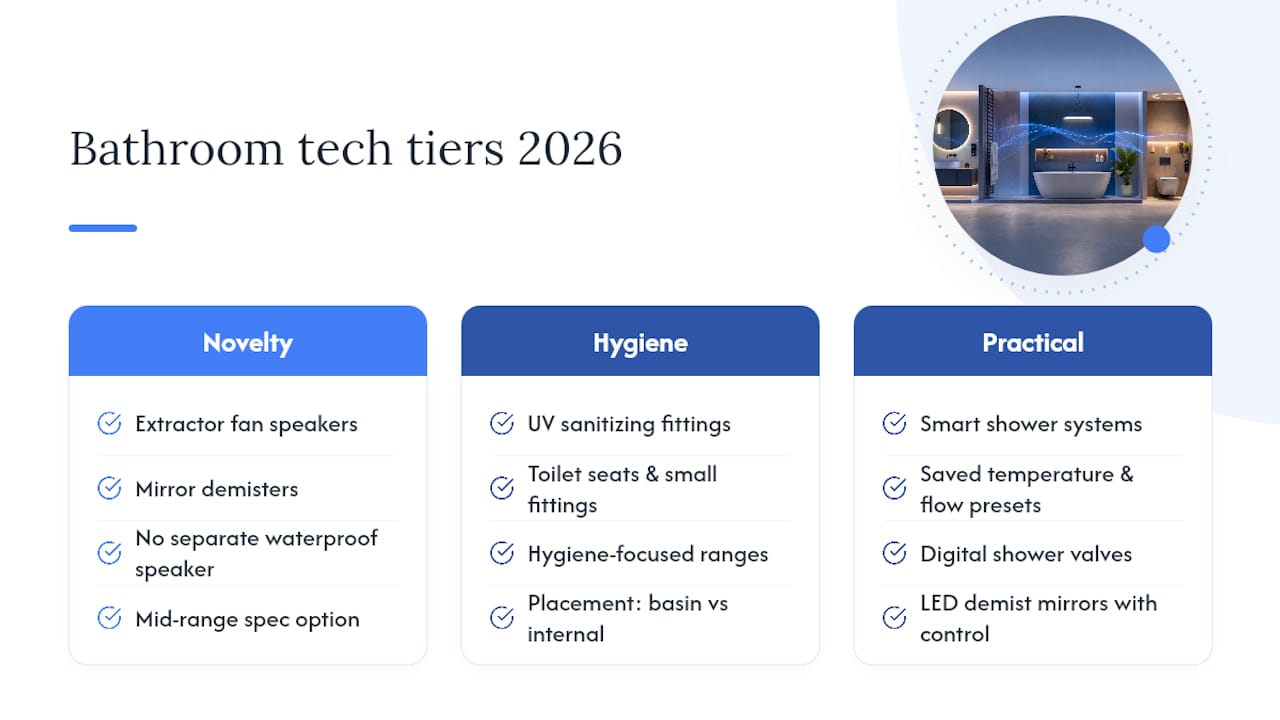
Integrated speakers built into extractor fans or mirror demisters have moved from novelty to a genuine spec option on mid-range bathrooms this year, letting you play audio without a separate waterproof speaker cluttering the shelf. UV sanitizing features, mostly built into toilet seats or smaller fittings, are also appearing more often on new product ranges aimed at hygiene-conscious households.
Smart shower systems that let you save a preferred temperature and flow rate are a more practical upgrade for most UK homes, since they solve a daily annoyance rather than adding a feature you’ll use occasionally. Digital shower valves, LED demist mirrors with built-in lighting control, and app-linked underfloor heating thermostats all fall into this more useful middle tier of bathroom tech.
The caution with any of this is straightforward: bathrooms are zoned spaces under UK electrical safety rules, and anything with a plug, a speaker driver, or a control panel needs to sit in a location that meets the IP rating for its zone. A UV sanitizing fitting near a basin is a different proposition to one buried inside a toilet unit. Run any tech addition past your contractor or a qualified electrician at the design stage, not after the tiles are down, because retrofitting wiring behind a finished tiled wall is far more disruptive than planning for it up front.
Ventilation and Humidity Control for UK Bathrooms
British weather makes ventilation a bigger deal here than in drier climates, and it’s one of the areas where a good-looking 2026 bathroom can go wrong fast if it’s skipped. Warm minimalist schemes lean on natural materials like limewash, timber vanities and matte plaster finishes, and all three are more sensitive to trapped moisture than the glossy tile-heavy bathrooms of a decade ago.
Extractor fans rated for continuous low-speed running, sometimes called trickle ventilation, are becoming the default spec on renovations rather than a fan that only kicks in on a light switch. Humidity-sensing fans that ramp up automatically when moisture levels spike are also worth the modest extra cost, particularly in windowless en-suites and internal bathrooms common in Victorian and Edwardian Cardiff terraces.
Cavity and wall ventilation matters beyond the extractor fan itself. Older properties often have blocked or missing cavity vents that let damp build up behind new tiling, an issue covered in detail in this guide to cavity wall vents. Getting airflow right through the wall fabric, not just the extractor, is what actually protects a limewash finish or timber vanity long term. If you’re planning a full refit, it’s also worth checking how your loft ventilation and insulation interact with bathroom extraction, since UK building regulations treat the two as connected systems in many properties, as this overview of loft insulation and building regs explains.
UK Regional Color Preferences Behind the 2026 Palette
The warm neutral base sitting behind 2026’s UK bathrooms isn’t arriving in a vacuum. It tracks a broader shift in British interiors away from the cool Scandinavian greys that dominated the last decade, toward tones that read as more grounded and less clinical. Sage green has become the accent color of choice specifically because it bridges warm neutrals and biophilic design, giving a room a sense of nature without committing to a full jungle theme.
Terracotta and warm clay tones are doing particularly well in period properties, where they sit comfortably against original brick, exposed timber, and reclaimed fittings that are common in Cardiff’s Victorian terraced housing stock. Deep navy remains popular as an accent, usually on cabinetry or a single wall, but it needs the lighting plan discussed earlier to avoid making a small, windowless bathroom feel smaller still. Coastal properties around the Vale of Glamorgan tend to lean toward the lighter end of the palette, stone, warm white and pale sage, which suits the brighter coastal light and keeps rooms feeling airy rather than heavy.
Sustainable Materials Beyond the Taps and Showerheads
Sustainability in 2026 bathrooms has moved past the water-saving fixture and into the cabinetry and countertop itself. Recycled and FSC-certified timber vanities are increasingly available from UK suppliers at a similar price point to standard MDF units, giving renovators a genuine eco upgrade without a significant cost jump. Composite stone surfaces made partly from recycled quartz offcuts are also appearing more often as worktop options, offering the stone-look finish without quarrying a fresh slab.
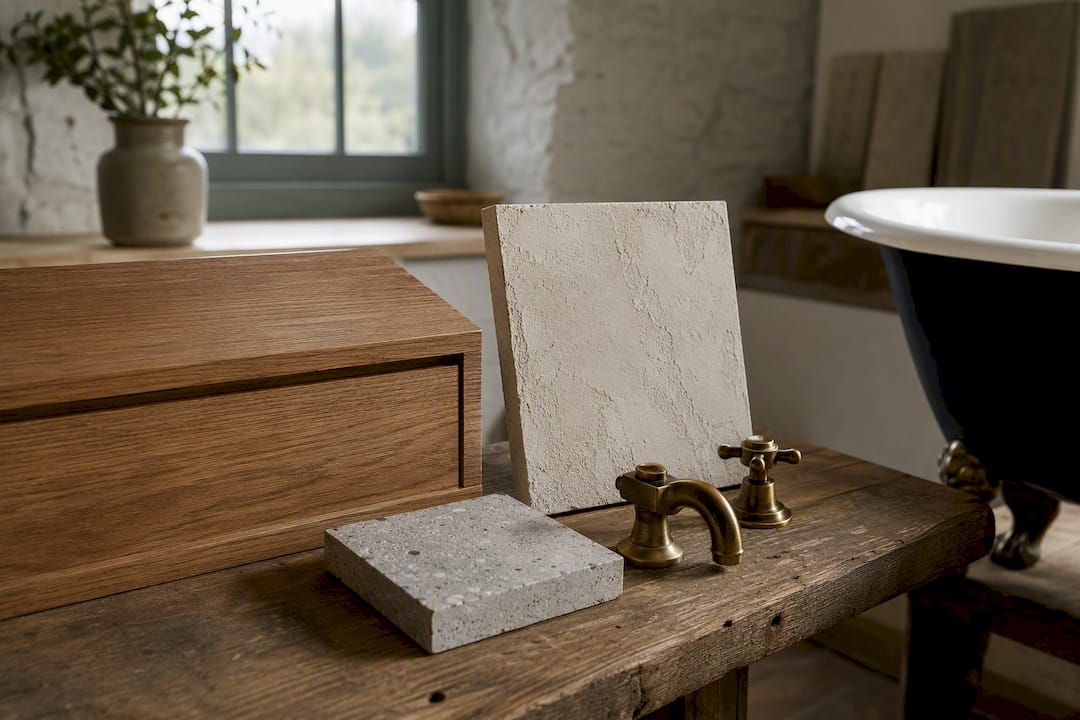
Limewash paint, already popular for its texture, has the added benefit of being a breathable, low-VOC finish that suits older UK properties with solid walls better than modern plastic emulsions. Reclaimed brassware and refurbished cast-iron baths are having a moment too, particularly among renovators working on period homes who want a sustainable choice that also fits the property’s character. None of this requires abandoning performance for principle. A recycled-content composite worktop performs identically to a virgin-material one; the difference is entirely in sourcing.
Which Trends Are Worth Choosing for Lasting Style
Warm minimalism is the safest long-term bet in this list. It’s a palette shift, not a gimmick, and it ages well because greige and warm stone were never going to look as dated as high-gloss white once did. Where I’d be more careful is with heavily bespoke artisan finishes, hand-thrown zellige across an entire room, a one-off reclaimed cast-iron bath, if resale value matters to you. They’re beautiful, but they’re also a specific taste that the next buyer may not share.
If you want the 2026 look without a full renovation budget, repaint in a warm neutral, swap the taps for brushed brass or aged bronze, and add a warm-white LED mirror. That combination alone changes the feel of a dated bathroom more than most people expect.
— James
Ready to Bring 2026 Bathroom Trends Into Your Home?
Jmplumbingservicesltd handles bathroom renovation as one accountable local team rather than a mix of subcontractors and showroom sales staff, which matters more than usual this year given how many 2026 trends (tile-drenching, wet rooms, warm minimalist finishes) depend on the tiler, plumber, and electrician actually coordinating with each other. Working across Cardiff and the Vale of Glamorgan, the team quotes fixed pricing upfront and backs it with 25 verified 5-star Google reviews, so there’s no showroom markup or upselling once the job starts.
Whether you’re after a full bathroom renovation in Cardiff, a wet-room conversion, dedicated tiling services for a tile-drenched finish, or general plumbing to sort out the pipework behind the scenes, every job gets the same attention regardless of size. Renovations typically require a budget in the mid-thousands of pounds for a full bathroom fit-out, and every project starts with an initial consultation to discuss layout, materials, and realistic timelines before anything is signed off. Get in touch to book yours and find out what a 2026-style bathroom would actually cost in your home.
FAQ
What is trending in bathrooms in 2026?
Warm minimalism and spa-inspired wellness design lead the year, built on earthy neutrals, textured large-format tiles, mixed metal hardware, and layered warm-white lighting between 2700K and 3000K.
What are some trendy bathroom wall decor ideas for 2026?
Tile-drenching a feature wall in a textured stone-look or zellige tile, or cladding one wall in limewash plaster, both deliver the tactile look without decorating the whole room.
What are some good ideas for a small bathroom in 2026?
Wall-hung basins and toilets, large-format tiles to minimize grout lines, recessed niches instead of shelving, and frameless glass screens all make a small room feel considerably larger.
What interior design trends are out for 2026?
Stark white suites, cool grey palettes, and small mosaic tiling with heavy grout lines are all fading in favor of warmer tones and large-format, low-joint surfaces.
How much does a 2026-style bathroom renovation cost in Cardiff?
A full bathroom renovation with Jmplumbingservicesltd typically varies in cost depending on tile choice, fixture specification, and whether the layout is changing.