
Water Hammer Pipes: Quick Fixes for UK Homeowners
Discover how to quickly fix noisy water hammer pipes in your UK home. Improve your plumbing today with these simple solutions!
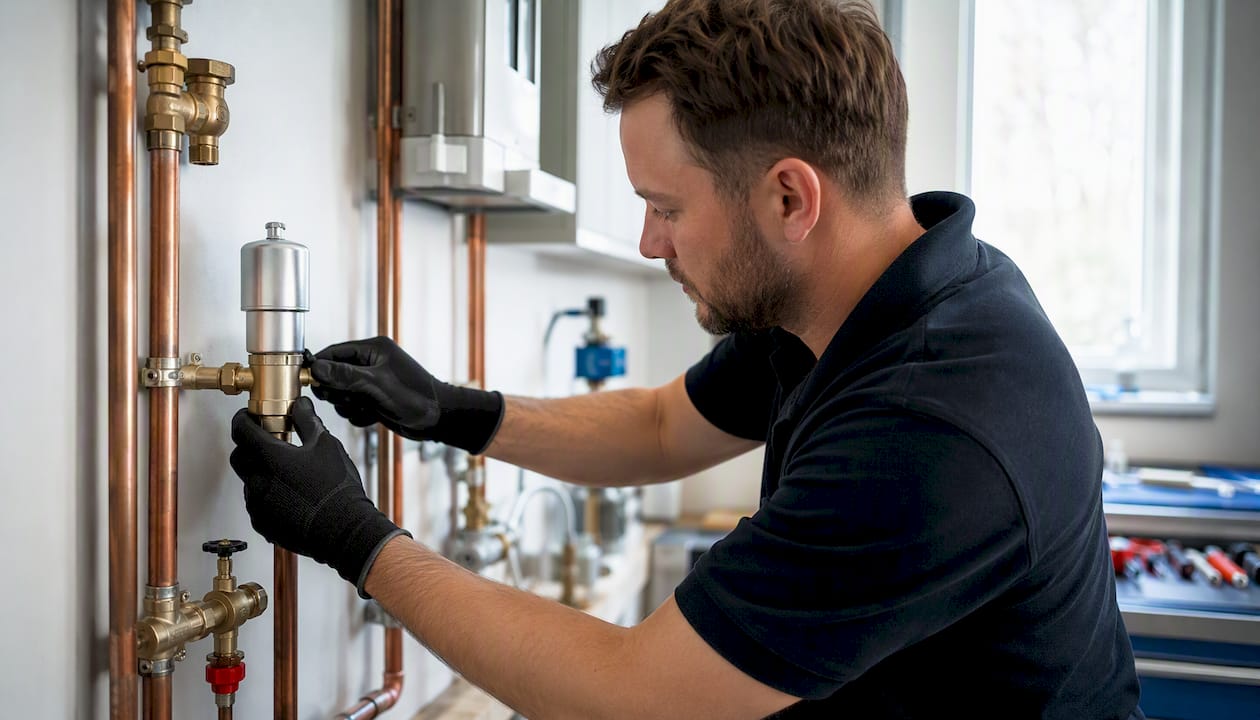
You can usually stop banging pipes today by checking your water pressure, securing any loose pipe runs, resetting waterlogged air chambers, and fitting a local arrestor at the noisiest fixture. Most cases of water hammer pipes trace back to one of three things: pressure that’s too high, a fitting that’s rattling loose, or a valve slamming shut too fast. A £10 to £15 pressure gauge tells you which problem you’ve got in under five minutes.
Here’s what actually works, roughly in order of how often it solves the problem:
- Check pressure with a hose bib gauge. UK homes should sit around 2 to 3 bar; anything consistently above 4 to 5 bar is a red flag.
- Secure loose pipes with extra clips, especially where they pass through joists or framing.
- Reset air chambers by draining the system from the highest point, then let it refill.
- Fit a screw on arrestor (£15 to £35) at the washing machine or dishwasher valve.
- Call a plumber if you see leaks, movement, or the banging keeps returning after these steps.
Bigger fixes, like a whole house pressure reducing valve, typically run £250 to £500 fitted and are a job for a qualified plumber like JM Plumbing Services Ltd, covering Cardiff and the Vale of Glamorgan.
Key Takeaways
Water hammer in UK homes is almost always solved by correcting pressure, securing loose pipework, or fitting a correctly sized and positioned arrestor.
| Point | Details |
|---|---|
| Check pressure first | Use a £10 to £15 hose bib gauge; UK homes should read 2 to 3 bar, not above 4 to 5 bar. |
| Secure loose pipework | Add clips every 30cm on runs that move, with foam isolators where pipes cross framing. |
| Size and place arrestors correctly | Follow PDI-WH 201 guidance and fit within about six pipe diameters of the offending valve. |
| Watch for red flags | Leaks, visible pipe movement, or repeat hammer after a DIY fix mean it’s time to call a plumber. |
| Get a proper diagnosis | Jmplumbingservicesltd tests pressure and diagnoses the cause on site across Cardiff and the Vale of Glamorgan before recommending a fix. |
Table of Contents
- What’s Causing the Banging in Your Water Hammer Pipes?
- DIY Fixes You Can Try Before Calling a Plumber
- When Should You Call a Professional Plumber?
- How Professionals Actually Fix Water Hammer Pipes
- Keeping Water Hammer From Coming Back
- Getting a Professional to Sort Your Water Hammer for Good
- Frequently Asked Questions
- Sources
What’s Causing the Banging in Your Water Hammer Pipes?
Work through this in order and you’ll usually have an answer within twenty minutes.
- Reproduce the noise. Turn taps on and off one at a time, run the washing machine fill cycle, and flush the toilet. Note exactly which action triggers the bang.
- Isolate the fixture. Shut off the isolation valve to that appliance or tap and see if the noise stops when you run other fixtures.
- Measure your static pressure. Screw a gauge onto an outdoor tap and read it while no water is running elsewhere in the house.
A bang that happens the instant a valve snaps shut is hydraulic shock: the moving column of water hits a dead stop and sends a pressure wave through the pipework. A rattle or knock that continues while water is flowing is usually mechanical, a pipe vibrating against a joist or bracket, not true water hammer at all.
Pro Tip: If the noise only started after you installed a new washing machine or dishwasher, check that appliance first. Modern high-efficiency solenoid valves close much faster than older models, which is often enough on its own to trigger hammer that never happened before.
If you spot a leak, see a pipe physically moving when the noise happens, or notice damp patches near a joint, stop testing and treat it as a job for a professional. Continued hammering against a weakened joint is how a nuisance noise turns into a burst pipe.
DIY Fixes You Can Try Before Calling a Plumber
Start cheap and work up. Most of these take under an hour and cost less than a takeaway.
- Secure loose pipe runs first. Copper and steel pipe should be strapped every 6 to 8 feet horizontally and every 8 to 10 feet vertically; PEX needs plastic hangers at similar intervals. Add extra clips every 30cm along any run that visibly moves, and slip a foam or rubber isolator wherever a pipe passes through a stud or joist.
- Reset your air chambers. Older UK homes often have capped vertical sections of pipe that trap air to cushion pressure surges. Turn off the mains, open the highest tap in the house to drain the system, then close it and turn the water back on. This lets air refill the chamber. It’s a five minute job, but don’t skip turning the mains off first, working on a pressurized system is how people get soaked or hurt.
- Fit mini arrestors at the appliance. Screw on arrestors installed directly at the washing machine or dishwasher shutoff handle most single appliance hammer. Sizing follows the PDI-WH 201 standard for residential use, and the arrestor needs to sit within about six pipe diameters of the valve that’s slamming shut, not further down the line.
- Check your isolation valves. Make sure stop taps are fully open, a partially closed valve can itself cause turbulence and noise. Where you find old quarter turn valves that snap shut in a quarter second, swapping them for slow close multi turn valves reduces shock at the source.
Total DIY time usually runs from a few minutes for a pressure check to an hour or two for strapping and arrestor fitting. Total cost typically stays under £50 unless you need several arrestors.
Pro Tip: Stop DIY work the moment a fix requires opening a wall, accessing pipework under a floor, or you find a fitting that looks corroded or damaged. That’s no longer a five minute job.
When Should You Call a Professional Plumber?
Some signs mean it’s time to stop troubleshooting and book a visit.
- Visible leaks, damp patches, or water staining near any pipe run.
- Pipes you can physically see or feel moving when the hammer occurs.
- Banging that returns within weeks of fitting arrestors yourself.
- Knocking that happens specifically in your central heating system rather than the cold or hot water supply.
- A pressure reading consistently above 4 to 5 bar, or above roughly 80 psi.
- Damaged fittings, corroded joints, or any sign the pipework has already been stressed.
Systems running above 80 psi are far more prone to hammer, and a pressure spike during a valve slam can hit five to ten times normal system pressure, enough to stress joints that have been fine for years. A standard callout for diagnosis plus a small fix typically takes one to three hours. Larger jobs, fitting a pressure reducing valve, arrestors throughout the house, or an expansion tank, usually take half a day to a full day depending on access.
Mains pressure reducing valve installation and any work involving your central heating pump genuinely need a qualified plumber. Get either wrong and you risk anything from no hot water to a damaged boiler.
How Professionals Actually Fix Water Hammer Pipes
Once a plumber has confirmed the cause, the fix usually falls into one of four categories.
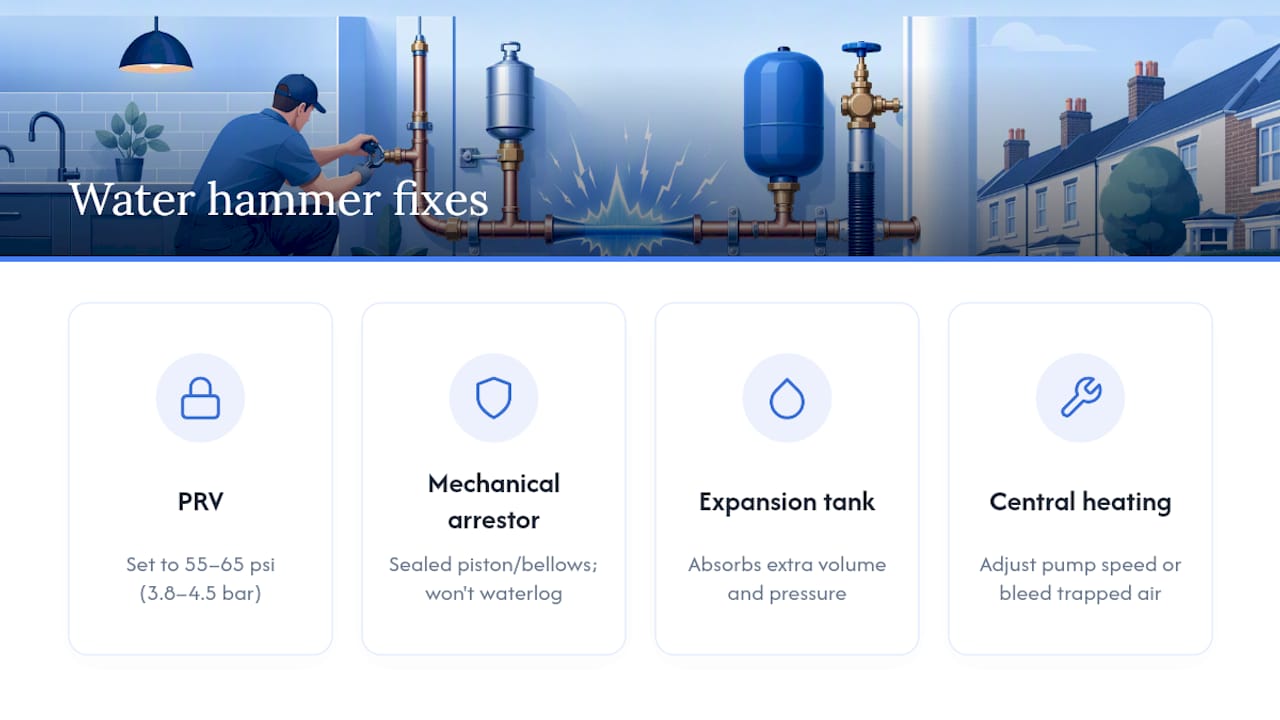
Pressure-reducing valves (PRVs). If your static pressure is running high, a PRV fitted at the mains supply is often the single most effective fix, because it addresses the root cause rather than treating symptoms fixture by fixture. Installing a PRV set to roughly 55 to 65 psi (about 3.8 to 4.5 bar) frequently eliminates hammer throughout the whole house without touching another pipe. UK guidance generally targets 2 to 3 bar for normal household operation.
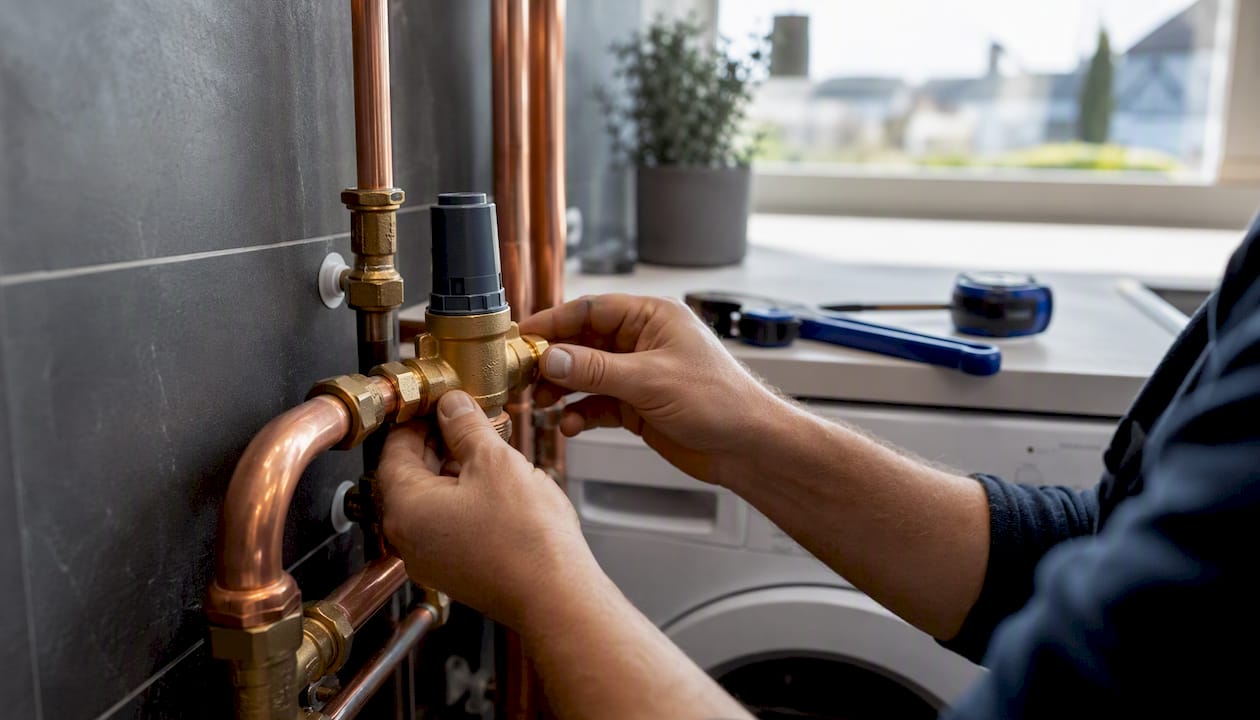
Mechanical arrestors. Unlike old air chambers, modern arrestors use a sealed piston or bellows that can’t waterlog, so they keep absorbing shock indefinitely rather than losing effectiveness after a year or two. Sizing and placement follow the PDI-WH 201 standard, and correct positioning within a few pipe diameters of the offending valve matters as much as the arrestor itself. One fitted six feet down the line from where it’s needed does very little.
Expansion or accumulator tanks. In a closed system, heated water expands and has nowhere to go without one. An expansion tank absorbs that extra volume and pressure, which matters most on unvented hot water cylinders and combi boiler setups common across newer Cardiff developments.
Central heating adjustments. Knocking that’s confined to your heating system is sometimes pump speed or trapped air rather than water hammer at all, something a heating engineer can usually resolve by adjusting pump settings or bleeding the system.
A common and costly mistake is fitting multiple arrestors around the house without ever checking mains pressure. If the underlying pressure is too high, you’re paying for parts that treat one symptom while the actual cause keeps stressing every joint in the property.
Keeping Water Hammer From Coming Back
A little routine maintenance keeps banging pipes from becoming a repeat problem.
- Recheck static pressure once a year with the same £10 to £15 gauge you used for diagnosis.
- Inspect pipe straps and hangers every few years, they loosen as timber shrinks and buildings settle.
- Check shutoff valves periodically for wear, especially older quarter turn types.
- Favor shorter branch runs over long straight lengths where you’re doing renovation work, and consider slightly larger supply pipe diameter to reduce water velocity.
Pro Tip: Don’t rely on old air chambers as a long-term fix. They waterlog naturally over time and quietly stop working, which is exactly why mechanical arrestors have become the standard retrofit. Homes with older bathrooms often benefit from addressing pipe layout during a wider renovation rather than patching fixture by fixture.
A local plumber’s view on water hammer in Cardiff homes
Across older housing stock in Cardiff and the Vale, capped air chambers that stopped working years ago are a frequent culprit, along with mains pressure that runs higher than expected in some of the hillier suburbs. A short on-site survey usually narrows the fix within the first visit rather than requiring guesswork.
Getting a Professional to Sort Your Water Hammer for Good
If the DIY steps haven’t stopped the banging, or you’d rather skip the troubleshooting entirely, Jmplumbingservicesltd offers something the arrestor kit from a hardware shop can’t: a proper on-site pressure test and diagnosis before any parts get fitted, so you’re not paying for guesswork. That matters because, as covered above, fitting arrestors without checking mains pressure first is one of the most common ways homeowners waste money on this exact problem.
A visit typically covers pressure testing at the stopcock, securing any loose runs found during inspection, and fitting whichever combination of arrestors, a PRV, or an expansion tank actually matches what’s causing the noise. Jmplumbingservicesltd works across Cardiff and the Vale of Glamorgan, including Penarth and Cowbridge, and the team’s day to day work in bathroom installation and general plumbing repairs means diagnosing hammer in local housing stock is a routine part of the job, not a specialty callout.
Before a visit, it helps to locate your internal stopcock, note which taps or appliances trigger the noise, mention any appliances installed recently, and clear access to the washing machine and dishwasher shutoffs. If the investigation turns up a leak or damaged fitting along the way, that’s worth flagging too, since it’s often cheaper to fix alongside the hammer than as a separate callout later.
Ready to get it sorted properly? Book a plumbing visit and get a firm diagnosis instead of another round of guesswork.
Frequently Asked Questions
Is water hammer in pipes dangerous? On its own, an occasional bang usually isn’t an emergency, but repeated hydraulic shock stresses joints and fittings over time and can eventually cause a leak or burst pipe, especially at soldered or compression joints.
Can I fix water hammer myself without calling a plumber? Often, yes. Checking pressure, securing loose pipe runs, resetting air chambers, and fitting screw on arrestors at appliance shutoffs solve most single fixture cases without professional help.
What pressure should my UK home’s water system be? A normal household reading is around 2 to 3 bar. Anything consistently above 4 to 5 bar raises your risk of water hammer and is worth having checked.
Why did water hammer start after I installed a new washing machine or dishwasher? Newer appliances often use solenoid valves that close much faster than older models, and that faster closure is frequently enough to trigger hammer that wasn’t there before.
How much does a professional water hammer fix cost in the UK? A diagnostic visit with a small fix typically runs a few hours of labor. A whole house pressure reducing valve installation generally costs in the region of £250 to £500 fitted, depending on access and pipework.
Sources
- Fixing water hammer (banging pipes) | PlumbingAdvice | Plumbing Advice
- How To Prevent Water Hammer - Causes, Fixes & Calculator | PlumberCalc
- Water hammer - Wikipedia