
Shower Pump Problems: Fix It Fast or Call a Pro
Struggling with shower pump problems? Learn quick fixes or when to call a pro. Troubleshoot common issues to restore your shower's flow.
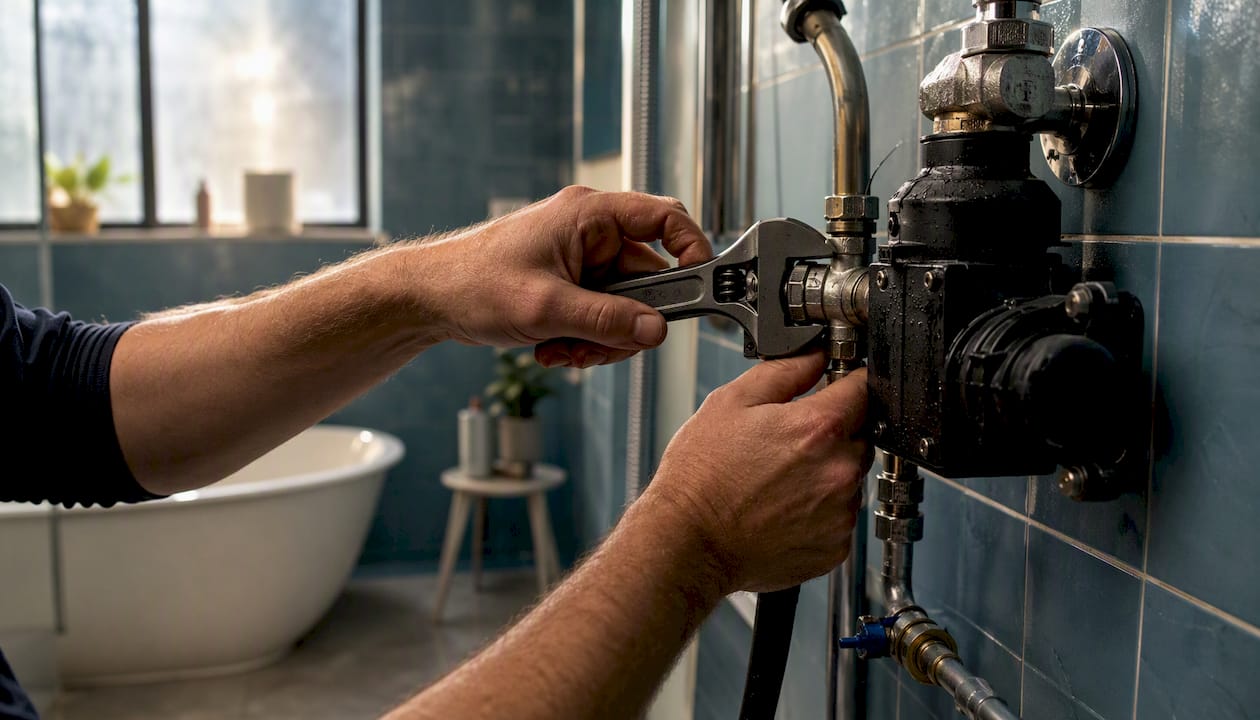
Most shower pump problems come down to four things: a tripped fuse or power cut, insufficient flow reaching a positive-head pump, an airlock or blockage, or a seized motor that’s hit its thermal limit. Before you call anyone, do two things. First, check the fused spur or circuit breaker serving the pump. Second, check whether your shower produces at least 2 litres per minute of natural flow per side — because positive-head pumps require that minimum to activate, and below that threshold they simply won’t start. If power is confirmed and flow is adequate, the fault is almost certainly a blockage, airlock, or worn component — all of which are fixable without replacing the unit.
Pro Tip: Before touching anything, note the pump’s make and model (usually on a label on the casing). You’ll need it if you call a manufacturer helpline or a plumber.
If basic checks don’t resolve the issue, Jmplumbingservicesltd covers Cardiff and the Vale of Glamorgan for same-day diagnostics and pump repairs.
Key Takeaways
Most shower pump faults trace back to power supply, insufficient natural flow, or installation quality — not the pump itself.
| Point | Details |
|---|---|
| Check power and flow first | Confirm the fused spur is live and natural flow meets the 2 L/min per side threshold before any other test. |
| Thermal cut-out needs time | After overheating or a dry run, allow 1–2 hours for the motor’s thermal cut-out to reset before testing again. |
| Clean filters and bleed air | Blocked inlet filters and airlocks are among the most common fixable causes of low pressure and pulsing. |
| Installation causes most noise | Anti-vibration feet, secure pipe clips, and correct pressure rating reduce noise more reliably than replacing the pump. |
| Jmplumbingservicesltd | Covers Cardiff and the Vale of Glamorgan for same-day diagnostics, pump repair or replacement, and full bathroom installations. |
Table of Contents
- What safety checks should you do before touching the pump?
- How do you match your symptoms to the most likely cause?
- What DIY tests and fixes can you safely try at home?
- Why do these problems keep happening?
- When should you stop DIY and call a professional?
- How do you prevent shower pump problems from coming back?
- What pump type suits your system?
- The part of shower pump advice most guides get wrong
- Jmplumbingservicesltd: local pump diagnostics in Cardiff and the Vale of Glamorgan
- Sources
What safety checks should you do before touching the pump?
Electricity and water in the same space is a serious combination. Never open the pump’s electrical enclosure while it’s live, and never work on the pump with wet hands or standing water nearby.
- Switch off the fused spur dedicated to the pump. If you can’t find it, trip the relevant circuit breaker at the consumer unit.
- Close the isolation valves on both the hot and cold inlets to the pump. These are usually slotted screws on the supply pipes — turn them 90° to close.
- Do not open the pump casing if you suspect an electrical fault. A buzzing pump that won’t spin, or one that repeatedly blows fuses, points to a seized motor — that’s a job for a qualified engineer.
- Wait before assuming it’s dead. If the pump ran dry or overheated, the thermal cut-out needs 1–2 hours to reset before the motor will attempt to start again.
- Check for standing water around the pump. Any visible leak near electrical connections means the power stays off until a professional has assessed it.
Pro Tip: If you’ve isolated the pump and there’s still water trickling through the shower, you likely have a dripping valve upstream. A dripping tap or valve can also cause a positive-head pump to hunt or run intermittently.
How do you match your symptoms to the most likely cause?
Different failure modes produce very different sounds and behaviors. Matching what you observe to the likely cause saves time and avoids unnecessary parts.
| Symptom | Most Likely Cause | First Quick Check |
|---|---|---|
| Completely silent | Tripped breaker, blown fuse, or thermal cut-out | Check fused spur; wait 1–2 hours after overheating |
| Pulsing or surging flow | Airlock, blocked filter, or scaled showerhead | Clean inlet filters; descale showerhead |
| Runs when all outlets closed | System leak or faulty pressure vessel | Isolate outlets one by one; check for drips |
| Noisy / vibrating | Poor mounting, loose pipes, or aeration | Check rubber feet and pipe clips |
| Low pressure on one side | Partial blockage or wrong pump type | Measure flow; run open-ended test |
| Won’t start (no noise) | Insufficient natural flow (positive-head) | Measure flow at shower outlet |
Aeration from incorrect installation is behind a large share of pulsing and noise complaints — and it damages seals over time, so it’s worth catching early. A pump that runs when all outlets are closed almost always signals a leak somewhere in the system; if you’re seeing that symptom, check for a shower leak through the ceiling or other hidden water damage before going further.
For positive-head pumps specifically: if natural flow from the tank drops below 2 L/min per side, the pump won’t activate, or it will start and stop repeatedly. That’s not a pump fault — it’s a system design issue.
What DIY tests and fixes can you safely try at home?
Work through these in order. The early steps are non-invasive; the later ones require the pump to be isolated first.
- Confirm power. Check the fused spur and consumer unit. Reset the breaker once. If it trips again immediately, stop — that’s a seized motor.
- Visual check. Look for kinked hoses, visible leaks at connections, and whether the pump is sitting level.
- Measure natural flow. Hold a jug under the shower outlet (pump off, isolation valves open). If you’re getting less than 2 L/min, a positive-head pump will never start reliably.
- Clean the inlet filters. Isolate the pump, depressurize by opening the shower briefly, then unscrew the filter housings on the inlet ports. Rinse under a tap. Blocked inlet filters are one of the most common causes of low flow and failure to start.
- Descale the showerhead and hose. Soak in white vinegar for 30 minutes. A scaled showerhead restricts flow enough to cause pulsing.
- Bleed the pump. With the pump isolated, open the bleed screw (if fitted) or briefly crack a union to release trapped air. Airlocks are a frequent cause of pulsing and can often be resolved without replacement.
- Run an open-ended test. Disconnect the outlet hose and let it run into a bucket with the pump on. If pressure is strong, the restriction is downstream (showerhead, hose, or valve). If it’s still weak, the fault is in the pump or supply.
- Rotate the pump to test each side. If one side is weak, swap the hot and cold connections temporarily to confirm which inlet has the problem.
Pro Tip: Always follow the pump manufacturer’s manual for filter cleaning and bleeding procedures. Salamander’s guidance is available on their support pages and covers model-specific steps that generic guides miss.
Why do these problems keep happening?
Understanding the root cause is the difference between a fix that lasts and one that fails again in three months.
Installation faults cause most noise and vibration. Fitting anti-vibration feet, using secure pipe clips, and avoiding oversized pressure ratings are the three highest-impact steps. A pump rated at 4 bar when 2 bar would suffice runs louder and wears faster. Loose pipes transmit vibration even when the pump itself sits on a rubber mat — swept bends instead of sharp 90° elbows reduce turbulence and cavitation noise materially.
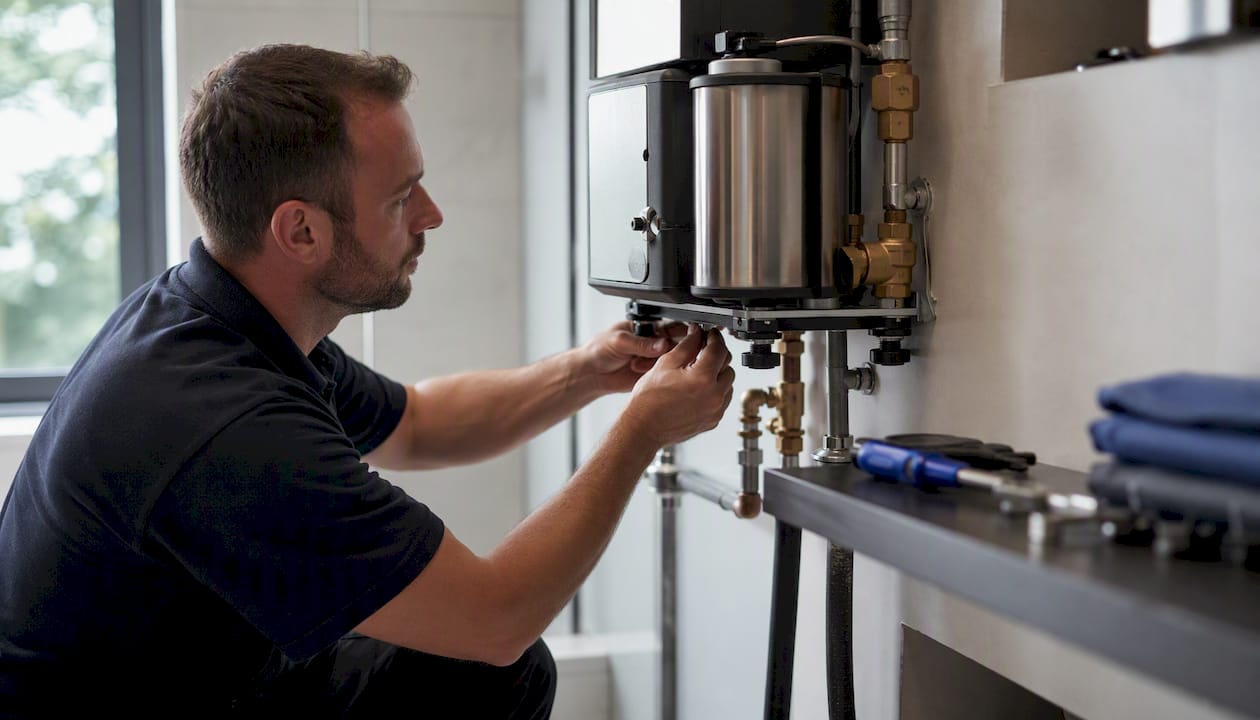
Enclosing a pump in a small cupboard without adequate airflow creates an acoustic chamber that amplifies vibration and causes the motor to overheat. Leave at least 80mm of clearance on all sides when boxing a pump in.
Aeration is the hidden killer. Air entering the pump through a poorly fitted flange or a supply pipe that runs dry damages shaft seals and impellers. Using a proper flange or dedicated feed reduces air ingestion and extends pump life considerably. Hot water above roughly 60°C in the cylinder can also damage seals — if your cylinder thermostat is set too high, the pump may buzz and struggle to start.
Wrong pump type for the system. A positive-head pump installed in a system with low natural flow, or a negative-head pump where a positive-head would work fine, creates chronic problems that no amount of maintenance will fix. Choosing the right pump for the head available is a design decision, not a product quality issue.
“Noise and vibration are more often the result of poor installation than product defect — correct mounting, anti-vibration pads, and avoiding oversized pressure ratings reduce complaints significantly.” — Installer Online
When should you stop DIY and call a professional?
Some faults are genuinely dangerous or beyond what a homeowner should attempt without specialist tools.
- Repeated blown fuses or tripped breakers after a reset almost always mean the pump motor has seized. Continuing to replace fuses risks fire or further damage — call a qualified engineer.
- Visible water near electrical connections on the pump or fused spur. Power off, stay out, call a plumber and electrician.
- Pump runs with all outlets closed and you can’t find an obvious drip. A hidden system leak can cause persistent hunting and will eventually cause water damage — check for a bathroom leak before it spreads.
- Persistent aeration after you’ve checked installation — this often means the supply pipework needs re-routing or a dedicated feed fitting.
- Pump is more than 8–10 years old and showing multiple symptoms. Repair costs can exceed replacement value at that point.
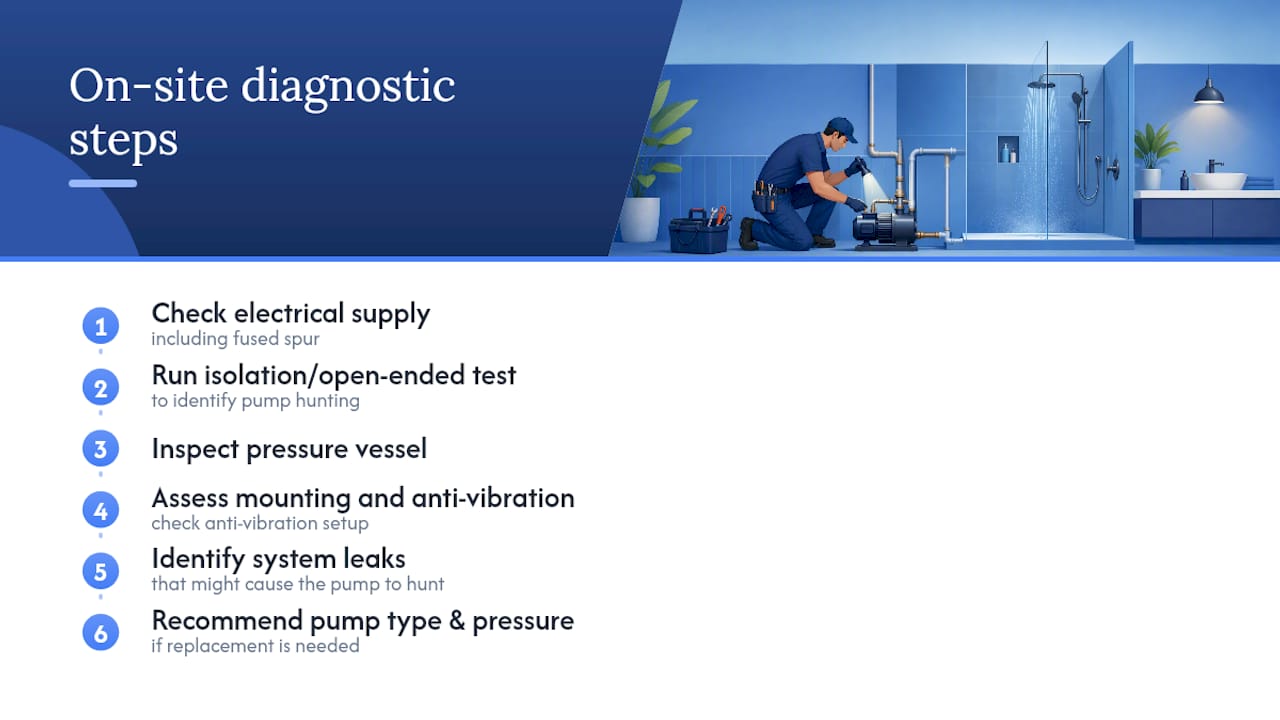
A qualified plumber will check the fused spur and electrical supply, run an isolation/open-ended test, inspect the pressure vessel, look for system leaks, and assess whether the pump needs re-siting or replacing. Most diagnostic visits in the UK can be completed same-day; straightforward repairs or pump swaps typically follow within one to two days depending on parts availability.
Have the pump’s make, model, and the results of any isolation test ready when you call — it cuts diagnostic time significantly.
How do you prevent shower pump problems from coming back?
A short maintenance routine handles most recurring faults before they develop.
Monthly: Visual check for drips at pump connections and isolation valves. Takes two minutes.
Every 6–12 months: Clean the inlet filters (more frequently in hard-water areas). Descale the showerhead and flexible hose. Check that pipe clips are still secure and that the pump hasn’t shifted on its anti-vibration feet.
Annually: Check the pump enclosure has adequate ventilation clearance. Confirm the isolation valves move freely — seized valves are a common discovery during emergency callouts.
Pro Tip: Keep a note of the pump’s installation date, model number, and location. Warranty claims and manufacturer support calls go much faster when you have that information to hand. Salamander Pumps, for example, offer extended warranty registration on their site.
For homes in hard-water areas (much of South Wales qualifies), descaling is the single highest-return maintenance task. Scale restricts flow, causes pulsing, and accelerates wear on seals. If you’re also dealing with slow drainage elsewhere in the bathroom, scale and debris buildup is likely a system-wide issue worth addressing together.
What pump type suits your system?
Centrifugal pumps are generally quieter than regenerative pumps because they move water by centrifugal force rather than the stripping action used in regenerative designs. Regenerative pumps can deliver higher pressure from a given motor size, but they’re more sensitive to air and debris and tend to run louder.
| Pump Type | Noise Level | Air/Debris Sensitivity | Typical Use |
|---|---|---|---|
| Centrifugal | Lower | Moderate | Most domestic showers |
| Regenerative | Higher | Higher | Where higher pressure is needed |
On head compatibility:
- Positive-head pumps need at least 2 L/min of natural gravity flow per side to activate. They’re suitable where the cold water tank sits above the shower outlet. Low natural flow causes hunting or failure to start.
- Negative-head (universal) pumps can draw water from a tank at the same level or below the outlet. They cost more and are slightly more complex to install, but they’re the right choice when natural flow is marginal.
Don’t over-specify pressure. A 3-bar pump in a system that only needs 1.5 bar runs louder, wears faster, and can stress older pipework joints. Match the pump rating to what the system actually requires.
The part of shower pump advice most guides get wrong
Most troubleshooting articles send you straight to the pump. Check the impeller, replace the seals, swap the unit. That’s the wrong starting point for the majority of faults.
The evidence is consistent: noise, pulsing, and failure to start are more often caused by installation quality and system design than by the pump itself. A pump sitting on bare floorboards with unsecured pipes and no anti-vibration mat will be noisy regardless of its brand or age. A positive-head pump installed in a system with marginal natural flow will hunt and fail to start no matter how many times you clean the filters.
The practical implication is that the diagnostic sequence matters more than the repair. Power first, then flow, then installation quality, then the pump internals. Skipping to the pump first wastes money and often leaves the real cause untouched.
There’s also a tendency to over-specify when replacing. Homeowners who’ve had a noisy pump often assume a more powerful unit will be quieter. It won’t. Higher pressure ratings correlate with more noise, not less. The right replacement is one that matches the system’s actual head and flow requirements — not the most powerful option on the shelf.
Jmplumbingservicesltd: local pump diagnostics in Cardiff and the Vale of Glamorgan
When the DIY checklist runs out and the pump still isn’t right, the fastest path to a fix is a professional who knows what to look for on arrival.

Jmplumbingservicesltd handles shower pump diagnostics, repair, and replacement across Cardiff and the Vale of Glamorgan. On a visit, the team checks the electrical supply and fused spur, runs an isolation/open-ended test, inspects the pressure vessel, assesses mounting and anti-vibration setup, and identifies any system leaks that might be causing the pump to hunt. If the pump needs replacing, they’ll recommend the correct type and pressure rating for your specific system — not just the nearest available model.
For homeowners whose pump issues are part of a wider bathroom problem, Jmplumbingservicesltd also covers full bathroom installations in Cardiff and renovation work that includes correct pump specification from the start. If you’re dealing with low shower pressure alongside pump faults, that’s worth mentioning when you call — the two are often connected.
Have your pump’s make, model, and the results of any isolation test ready. Book a visit with Jmplumbingservicesltd to get a same-day diagnostic and a straight answer on repair versus replacement.
Sources
- My positive head shower pump will not start - what should I do? | Salamander Pumps
- Shower pump troubleshooter | Pumpworld
- CT Xtra support | Salamander Pumps
- Why won’t my shower pump start? | Checkatrade
- Reducing noise in water pump installations - What installers need to know | Installer Online